

British houses are very good at one thing: holding on to heat. In February, that’s exactly what you want. In the middle of a heatwave, it’s a different matter entirely. The same building that keeps you warm through a damp November becomes an increasingly stubborn problem when the temperature climbs and refuses to drop overnight.
In this video I look at the physics behind why British homes behave the way they do in hot weather, and what you can actually do about it. Not as a science lecture, but as a framework for making practical household decisions.
Every time Britain gets a heatwave, someone points out that it’s hotter in Spain and people there manage perfectly well. True. But Spanish buildings are designed with heat in mind. External shutters, tiled floors, shaded layouts, and a daily rhythm that acknowledges midday is not the time to be maximally active. British homes are built around cold and damp. Brick that retains heat, carpet, loft rooms, conservatories that behave like greenhouses, and curtains or blinds sitting on the inside of the glass. The building itself is working against you before you’ve even turned on a kettle.
Understanding why that happens makes the advice make sense. There are four ideas that do most of the work.
Radiation: stop sunlight before it becomes indoor heat
Sunlight carries energy. When it comes through a window and hits a surface inside the room, that surface absorbs the energy and warms up. At that point, you’re no longer dealing with outdoor sunlight. You’re dealing with heat that is already inside the building.
This is why external shade is so much more effective than curtains. If a shutter, awning, shade sail, or tree stops the sunlight before it reaches the glass, most of that heat stays outside. If sunlight passes through the glass and hits an interior curtain, the curtain may block the glare, but it is now a warm object sitting inside your room.
Curtains are still worth using. They reduce direct sunlight hitting surfaces deeper in the room, cut glare, and make a space more livable. But they sit further down the chain than external shade.
A rough hierarchy looks like this:
- External shade (shutters, awnings, shade sails, trees, anything safe outside the glass) stops heat before it enters
- Reflective measures close to the glass, with the shiny side facing outward, can help deflect some energy
- Curtains and blinds inside the room reduce glare and slow the spread of heat through the space
- Dark fabric absorbing sunlight inside the room is the weakest option, blocking glare while itself becoming a heat source
Not all windows are the same problem. East-facing windows make mornings difficult. South-facing windows get sustained sun. West-facing windows can be brutal in the afternoon, exactly when the house is already warm. Skylights and roof windows deserve particular suspicion because they take direct overhead sun with nowhere for it to go.
Walk around the house on a hot morning and notice which curtains are warm to the touch, which rooms get blasted in the afternoon, and which windows are turning a room into a greenhouse. No specialist equipment needed. A hand on the curtain and a cheap thermometer will tell you what you need to know.
The timing matters too. By the time a room is roasting, you are already managing the consequences. The work happens before the sun gets there. Close curtains on the sunny side early. If something is sitting in direct sun soaking up heat, move it if you can. A bedroom that spends all afternoon charging up will not forgive you at midnight.
Convection: windows are a tool, not a virtue
Moving air can feel helpful. It can also be a hairdryer. The difference is whether the air outside is cooler than the air inside.
If it is 35°C outside and 28°C inside, opening a window might make you feel better briefly because air is moving across your skin. But you are also pulling hotter air into the building. The person may feel a momentary improvement while the room gets worse. That trade might sometimes be worth making, but it is worth knowing that is what you are doing.
The basic rule is straightforward. When outside is cooler than inside, ventilation is your friend. When outside is hotter than inside, be cautious about opening the hot side.
The day has distinct phases. Early morning may be the best window for ventilation, while the outside air is still relatively cool. By midday, you are in a defensive position. Curtains closed, sunny-side windows shut, activity reduced. Evening is your next opportunity, depending on how quickly the outside temperature drops. At night, cooler outdoor air can help flush stored heat out of the house, but you need a route for it to travel. One open window often creates no useful airflow. Cooler air needs a way in and warmer air needs a way out.
A cheap indoor-outdoor thermometer takes the guesswork out of this. It settles the household argument between the person who wants to open everything because it feels stuffy and the person who says it is hotter outside. Without one, both sides are arguing from vibes. With one, you know whether the air outside is currently helping or making things worse.
Security, children, pets, insects, noise, and the layout of your property may all limit what you can realistically open and when. If you cannot ventilate properly, a fan can still help the person in the room feel cooler, but it is not doing the same job as replacing hot indoor air with cooler outdoor air. Know what you are achieving.
Thermal mass and thermal lag: the house that charges up
Heavy materials absorb heat slowly and release it slowly. Brick, concrete, roof spaces, walls, paving, and the structure of the building itself all do this. Thermal lag is the delay between the heat going in and you experiencing the consequences. The house spends the day absorbing energy and then pays it back through the evening and night.
This is why heatwaves often feel worst after sunset. The sun is down, the light has faded, but the loft space is still radiating heat downward through the ceiling. South and west-facing walls are still releasing what they absorbed during the afternoon. Upstairs bedrooms take heat from the roof above, the walls around them, and the ceilings below the loft. Urban areas can compound this further: roads, car parks, and dense buildings form a heat store that releases energy slowly through the night.
Loft spaces deserve a particular mention. They can become extremely hot, and that heat sits directly above your upstairs ceiling and radiates down. A loft hatch that closes poorly or is uninsulated can become part of the problem. As a long-term measure, checking whether the loft hatch closes properly and is adequately insulated is worth doing.
The tip to open the loft hatch during an evening cooling purge can work in some houses, but it is worth testing rather than assuming. Open windows downstairs so cooler air has a route in, crack the hatch, and give it fifteen to thirty minutes. If the landing cools and air starts moving, useful. If it feels hotter, dusty, or stale, close it. Your loft may behave as a chimney or as a roof oven, and the only way to find out is to check.
The other practical application of thermal mass thinking is identifying your cool zones before you need them. The north-facing room with less direct sun. The tiled bathroom. A downstairs hallway. A basement if you have one. Many people do not have a perfect cool room, but identifying the least bad option before the worst night of a heatwave is far better than discovering it at midnight.
Think about it in practical terms. Which room is coolest in the morning? Which is worst in the afternoon? Where could someone vulnerable sit during the hottest part of the day? If you did move downstairs for a night or two, would you need to bring a fan, bedding, medication, or a water bottle with you?
Internal heat gain: the enemy within
If an appliance uses electricity inside the house, most of that energy eventually becomes heat. Sometimes that is the intention, as with a kettle, oven, hob, toaster, tumble dryer, or heated towel rail. Sometimes heat is a byproduct, as with a gaming laptop, desktop PC, games console, or large television. In a heatwave, the distinction barely matters. Indoor watts become indoor heat.
A gaming laptop running a demanding task draws a substantial amount of power. That power ends up as heat in the room. A desktop PC with multiple monitors, a games console, and a large screen in a small study is effectively a cluster of heaters with a productivity justification. Before wondering why the study is unbearable, it is worth noticing what is running in it.
A plug-in power meter is genuinely useful here. A few spot readings can change how you think about the room. A fan might use relatively little power. A dehumidifier, tumble dryer, or gaming laptop is a different matter entirely.
Some practical adjustments are straightforward. A tablet for watching something uses far less power than a gaming laptop. Cold food, microwave meals, or batch cooking done early in the morning avoids turning the kitchen into an additional problem. If cooking indoors is unavoidable, use the least aggressive method, keep it short, and if the outside air is cooler, use ventilation to push heat and moisture out rather than trap it inside.
Boiling only the water you actually need feels like a small thing. In a heatwave, it is one of the simplest ways to avoid adding unnecessary heat to the kitchen.
If heat-producing chores have to happen, do them early before the house has fully charged up. Postpone the tumble dryer if the house is already struggling. Turn off the heated towel rail if it has been quietly running unnoticed. And do not overlook the contribution of people and pets in the room. Poor sleep compounds bad decisions, which can include things like cooking a full meal in an upstairs flat at the hottest point of the evening.
Putting it together: manage the house, not just the moment
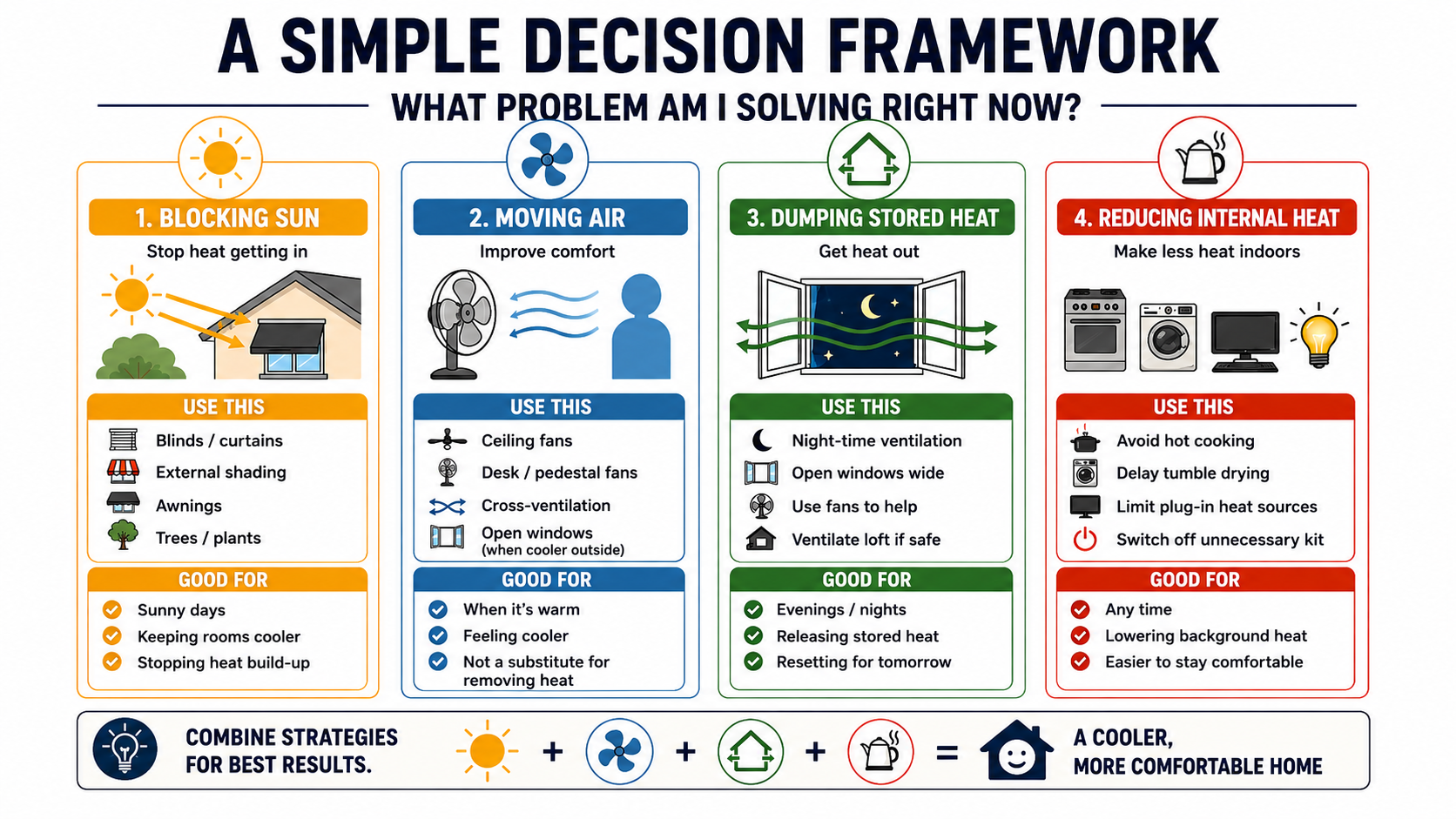
A British heatwave is not simply a high number on a weather app. It is sunlight entering through glass and becoming indoor heat, hot air moving in or cooler air failing to move through, a building spending the day absorbing energy and giving it back at night, and a household adding more heat on top of all of that.
Radiation says to block sun before it crosses the threshold and becomes a room temperature problem. Convection says to use windows deliberately based on whether outside air is currently helping or making things worse. Thermal mass says to act early, because the house stores energy and pays it back later regardless of what the sun is doing. Internal heat gain says not to undermine your own efforts with unnecessary appliances, overfilled kettles, and afternoon cooking.
If a bedroom is hot because a west-facing window has been in full sun all afternoon, a fan at midnight is managing the aftermath of something that could have been addressed twelve hours earlier. If the house is still warmer inside than outside, opening every window may be importing the problem rather than solving it. If the outside air cools in the evening and you keep everything sealed, you may be missing the best opportunity to dump stored heat.
The morning is where you set the house up. The daytime is where you defend it. The evening is where you try to counterattack by releasing stored heat. Night is where you protect your sleep. Throughout all of it, you reduce what you add yourself.
Once you understand what the house is actually doing, heatwave advice stops being a collection of contradictory tips. You know why something works, when it works, and when it is making you feel better while the house gets quietly worse. A future video in this series will cover the practical side of cooling: fans, spray bottles, ice packs, humidity, dehumidifiers, portable air conditioners, and the important difference between cooling a room and cooling a person.