

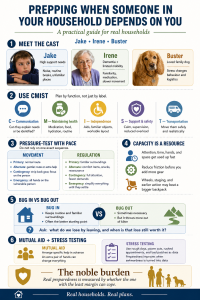
Most preparedness content is written for a household of capable, mobile, self-sufficient adults. It assumes everyone can grab a bag, move quickly, and adapt on the fly. For a lot of people, that assumption quietly collapses the moment it meets real life.
In this video, I work through what preparedness actually looks like when one or more members of your household change the logistics of everything. Not in the abstract, but through three specific examples: Jake, an eight-year-old with high support needs whose behaviour tracks the household atmosphere closely; Irene, an elderly relative living with dementia and limited mobility who depends heavily on familiarity to stay regulated; and Buster, a good dog right up until the household is under strain.
These are not edge cases. They are the people many of us are genuinely planning around, and the usual prep content writes them out of the picture entirely.
Responsibility, not independence
Preparedness is often framed as a project of self-reliance. But for many households, that framing does not fit at all. The real project is responsibility. It is knowing that someone in your world cannot simply be treated as a capable adult in a difficult situation, and then planning honestly around that.
A useful way to shift your thinking is to treat the needs of a vulnerable household member as a system requirement rather than a complication. You do not get angry that the river is in the way. You plan the bridge with the river already in mind. The same logic applies here. The question stops being “how do I make this person less inconvenient?” and becomes “what does the plan need to do well if this person is to stay safe?”
A better framework than labels
When people think about vulnerability in emergency planning, they often reach for diagnostic labels. Autism, dementia, disability. But labels do not tell you very much about what a household actually has to do when things go wrong.
The US Centers for Disease Control and Prevention uses a framework called CMIST in its guidance on emergency planning for people with access and functional needs. It stands for Communication, Maintaining Health, Independence, Support and Safety, and Transportation. The value of this framework is that it pushes you away from labels and towards the actual planning problem.
Worked through the three examples, a pattern starts to appear quickly.
Communication. Jake may not be able to explain who he is or what he needs, particularly when overwhelmed. Irene may not reliably be able to tell people what medication she takes or whether she has taken it, especially when tired or in an unfamiliar place. Buster cannot speak at all, which means tags, a microchip, and other people quickly understanding he is a loved family dog rather than a stray suddenly matter a great deal.
Maintaining health. For Jake, that may mean accepted foods, medication, and routine anchors that prevent distress from escalating. For Irene, it means medication, continence supplies, warmth, hydration, and proper rest. For Buster, food, water, any medication, and the familiar bits of routine that keep him settled.
Independence. Not in the rugged self-reliance sense, but in the sense of preserving whatever helps the person function as well as they can. For Jake, that may be familiar objects, headphones, or a preferred way of communicating. For Irene, it may be glasses, hearing aids, a walking frame, and a familiar room layout. For Buster, his usual lead, bed, blanket, and the everyday cues that tell him life is still broadly sane.
Support and safety. Jake may be overwhelmed by noise, bright light, and disrupted routine. Irene may become more confused and distressed if she is rushed, cold, or in a strange place. Buster may shift from relaxed and settled to barking, pacing, or refusing to move because the household feels wrong. In all three cases, the atmosphere itself can make things considerably worse.
Transportation. Jake may freeze, refuse to move, or only cooperate if something familiar is involved. Irene may be slow and unsteady, with stairs and rough ground presenting real problems. With dementia, capacity can vary enormously between a good day and a difficult one. Buster may pull hard, hate the car, or need one person entirely focused on getting him in and settled. In each case, movement takes longer, takes more effort, and may need more equipment than the plan assumed.
Lay it out that way and it becomes clear why so many plans quietly fall apart. Not because someone forgot to buy an extra torch, but because the real friction in the household was never honestly accounted for.
Using PACE for a household that has less margin
PACE stands for Primary, Alternate, Contingency, Emergency. I covered this framework in an earlier video on redundancy, but it earns its keep here because vulnerable household members punish single point of failure plans very efficiently.
For movement, consider what that looks like with Jake. Primarily, get him into the car early, before the atmosphere in the house deteriorates. If that does not work, use a familiar stroller or buggy. If that fails, one adult focuses entirely on Jake while the other handles the practical load. At the emergency tier, everyone needed is on Jake, and everything else is stripped to the absolute minimum or left for later.
The same structure applies to Irene. Primarily, a calm transfer to the car while she is still reasonably settled. If that is not straightforward, the route is adjusted to avoid stairs, and someone brings the car to the door rather than expecting her to cover the distance. At the contingency level, a wheelchair or fully assisted movement at a much slower pace. At the emergency level, all available hands on Irene, with the practical aftermath dealt with once she is safe and settled.
And Buster. Primarily, into the car in a calm and familiar way. If he is not cooperating, a designated handler with familiar cues, reassurance, and his favourite things. If he is genuinely unsettled, one person focused entirely on him with the rest of the load simplified. At the emergency tier, everyone who is needed helps get him moved and settled, with the rest sorted afterwards.
The point of PACE here is not to sound tactical. It is to stop the plan from collapsing the moment one assumption fails.
Capacity is finite and honest planning starts there
One of the less glamorous truths in all of this is that some household members do not simply add another mouth to feed. They absorb capacity. Jake takes attention, calm, and routine. Irene takes time, physical effort, and patient handling. Buster, under stress, can consume time, space, and attention at exactly the wrong moment.
If Irene needs both your hands to get down the stairs, those hands are not carrying water, bags, or the dog crate. If Jake needs your full attention to stay regulated, you are not also running a tidy household emergency response. If Buster cannot be left loose in the middle of everything, that is one more piece of your capacity already spoken for.
Once you accept that honestly, the planning tends to improve quite quickly. You stop thinking about carrying more and start reducing friction. You store things where they are actually needed. You simplify. You lighten bags. You accept that the right answer might be wheels rather than a rucksack, and earlier action rather than more action.
Place matters as much as kit
A lot of preparedness focuses on what you own. But for a household like this, where things are means as much as what things. Prepositioning is the honest word for it. Having the right things in the right place before anyone is tired, frightened, overwhelmed, or in pain.
At home, the question is whether the environment helps or hinders the person who has the least margin. Are Jake’s comfort items and familiar routines accessible, or are they buried in an emergency box that will not be found until it is too late? Is Irene’s medication easy to locate in low light? Is the downstairs genuinely workable if stairs become a problem?
The car matters too, in a plain practical sense rather than a dramatic one. Who gets in first? What needs to stay within reach? What is buried in the boot under gear that sounds useful but will not actually be needed? If Jake is struggling, Irene needs a slower transfer, or Buster is unwell, has the vehicle been arranged around reality or around tidiness?
Then there is the destination. Not just whether it has power and running water, but whether it is actually usable for your household. Is there somewhere quiet for Jake? Is there a downstairs space for Irene, and somewhere familiar enough not to disorient her badly? Is there room for Buster’s bed, bowl, and the practical mess that comes with a stressed animal in someone else’s house? If you may need to rely on another location, ideally some of what you need should already be there before you arrive.
Bugging in deserves more credit
There is a tendency in preparedness to treat leaving home as the obvious response to a crisis. For a household with someone like Jake, Irene, or Buster, that assumption is worth questioning.
Home is usually where the adaptations already live. The familiar layout, the accepted foods, the medication in the right place, the quiet corner, the dog’s territory, the routines and cues that give everyone a fighting chance of staying regulated. When preppers speak as though movement is automatically the right answer, it is worth pushing back on that a little.
Bugging out throws a great deal out of kilter all at once. Jake may lose the very objects and routines that help him cope. Irene may become more confused and harder to reassure in an unfamiliar place. Buster may manage far worse in transit or in someone else’s home than he ever would in his own. And all of that is happening while the adults are simultaneously trying to move gear, make decisions, and handle the crisis itself.
That does not make leaving wrong. Sometimes home stops being workable and there is no other sensible option. But for some households, bugging out should be treated as a genuine threshold rather than a default starting point. The honest hierarchy often looks something like: normal life with whatever adaptations are already in place; staying home during a crisis, aiming to preserve as much familiarity and function as possible; and then leaving, when staying is no longer a viable option and the disruption of moving is still the lesser cost.
The value of one extra pair of hands
If you are managing Jake, Irene, and Buster on a difficult day, one additional person can make a meaningful difference. Not a full community response network, just one or two people who already understand the household and will not be thrown by the awkwardness of it.
That might be a neighbour, a relative, a friend, or another parent. Someone who can lift, drive, sit with Irene for half an hour, calm things down, or fetch what is needed while the rest of the household is fully stretched.
The time to arrange that is before the difficult day arrives. The family across the road may be perfectly happy to take Buster for a while if things go sideways. The carer who normally comes on Thursdays may be willing to stay longer or come at short notice if everyone already knows what the plan looks like. A friend may be glad to act as an extra pair of hands, but only if the conversation has happened in advance.
Help is most useful when it is specific. Not “call me if you need anything”, but “if the power goes and Jake is struggling, could you come and sit with Irene for thirty minutes?” or “if we have to leave quickly, can you take Buster until we know where we are landing?” Planned help becomes part of the preparedness layer rather than something improvised under pressure.
Testing the plan without making life harder than it already is
None of this is worth much until it has been tested in some form. That does not have to mean a formal exercise or deliberately adding stress to a household that may already have plenty.
Where a deliberate test is possible, it is worth trying. A planned evening without power, locating Irene’s medication in low light, loading the car quickly while Jake is already stressed and Buster is already restless, feeding people from stored supplies without leaning on the usual brands, seeing how things run with one adult absent.
Where that kind of test is not realistic, the halfway house is to pay attention to the minor stress tests that life provides anyway. A rough evening, a power cut, a bad patch for Irene, Jake becoming overwhelmed while you are already tired, a rush hospital appointment, a disrupted routine, one car not starting. These moments are already giving you information if you are willing to notice it.
The aim is not to confirm that the plan is working well. The aim is to find where it catches. If Jake rejects the headphones you were relying on, that tells you something. If Irene’s comfort items are in the wrong room, that is useful data. If the walking frame does not fit the route you had imagined, or if the whole plan only works when two calm adults and both cars are available, that is something worth knowing well before everything else goes wrong.
The burden you carry on purpose
There is a phrase I find useful for all of this: the noble burden. It sounds slightly grand, but I think it earns its place.
Burden is the honest word. Pretending there is no burden does not honour the person you love. It just leaves you less ready to carry it. If someone in your household requires more from the plan than most people do, then yes, that creates a genuine load. But it is a load you carry on purpose. Not because it is efficient, and not because it makes for good preparedness content, but because they are yours.
Real preparedness is not measured by whether the strongest person in the household can push through discomfort and make it through the night. It is measured by whether the one with the least margin can. If your plan is good enough for them, it is probably in reasonable shape for everyone else too.
If this speaks to your household’s situation, I would be glad to hear in the comments what kind of planning friction you are actually dealing with. Mobility, communication, medication, routine, regulation, transport, supervision, or something else that rarely comes up in the usual preparedness conversations. And as a practical exercise, try building your own version of Jake, Irene, and Buster. Your own two or three examples, worked through honestly, using the CMIST questions. See where the plan starts to creak.